

AdSpectra: Turning a Sales Prediction Model into a Real Product
Sales prediction is one of the most valuable applications of data science. It influences marketing strategy, budget allocation, and business planning. While building a prediction model is relatively common, deploying it as a usable product is where most projects stop.
AdSpectra was created to go beyond experimentation.
The goal of this project was to take a machine learning sales prediction model and deliver it as a production-ready web application — one that real users can interact with, understand, and trust. AdSpectra allows users to input advertising spend and instantly receive sales predictions supported by visual insights.
This blog explains how the project was designed, implemented, and refined into a complete system.
What AdSpectra Does
AdSpectra is a full-stack sales prediction application with three core objectives:
- Generate real-time sales predictions
- Provide visual analytics to support those predictions
- Abstract machine learning complexity behind a clean user interface
The focus is not just prediction accuracy, but usability and clarity.
Core Features
Real-Time Sales Prediction
Users enter advertising spend for:
- TV
- Radio
- Newspaper
The frontend sends this data to a backend API, which processes it using a trained regression model and returns a predicted sales value.

This prediction happens in real time, meaning users can quickly adjust inputs and immediately observe how changes in advertising spend impact expected sales.
Why this matters: Instead of treating sales forecasting as a static report, AdSpectra makes it interactive, enabling experimentation and better decision-making.
Analytics & Visual Context
Predictions are supported by visual analytics that show:
-
Advertising Spend vs Sales Relationship Graphs illustrate how changes in advertising expenditure influence sales values, helping users understand the direct relationship between input variables and predicted output.
-
Historical Data Patterns Visualizations are generated from historical advertising and sales data, allowing users to observe trends and patterns used by the prediction model.
-
Channel-wise Comparisons Individual comparisons for TV, Radio, and Newspaper advertising highlight the relative contribution of each channel to sales performance.
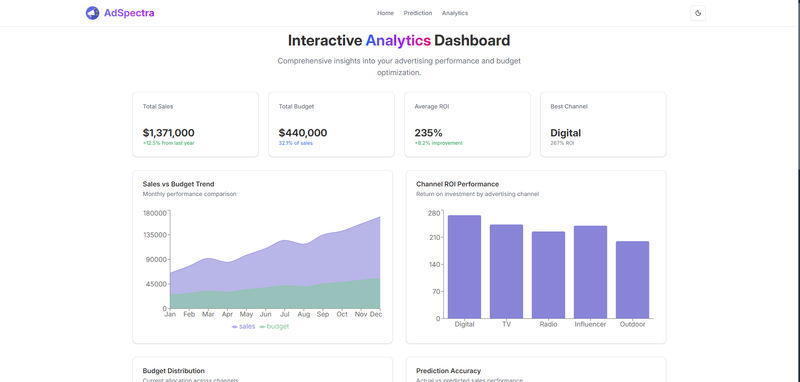
Result: Users can interpret predictions instead of blindly trusting them.
System Architecture
AdSpectra follows a layered, decoupled architecture, ensuring scalability and maintainability.
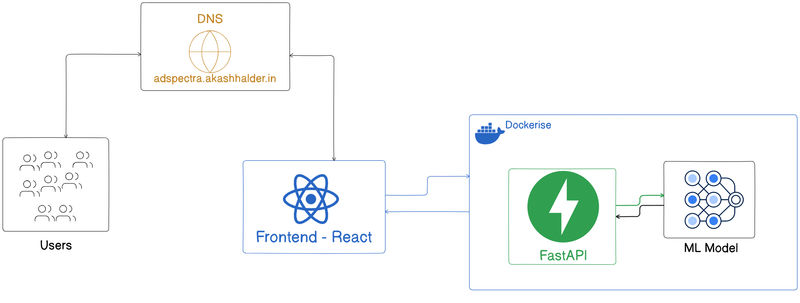
Each layer has a single responsibility, making the system easier to debug and extend.
Technology Stack
| Layer | Technology |
|---|---|
| Frontend | React |
| Backend | Python REST API |
| Machine Learning | Python, Pandas, Scikit-learn |
| Visualization | Chart components |
| Deployment | Vercel |
Machine Learning Implementation
The prediction engine was built using Python and Scikit-learn.
- A regression model trained on historical advertising data
- Features include TV, Radio, and Newspaper spend
- Model evaluation performed using RMSE
- The trained model serialized for efficient inference

Training and inference were separated to ensure fast response times in production.
Frontend Implementation
The frontend is built with React, focusing on responsiveness and clarity.
Key responsibilities:
- Collecting user inputs
- Making asynchronous API calls
- Rendering predictions and analytics
- Maintaining smooth user interaction
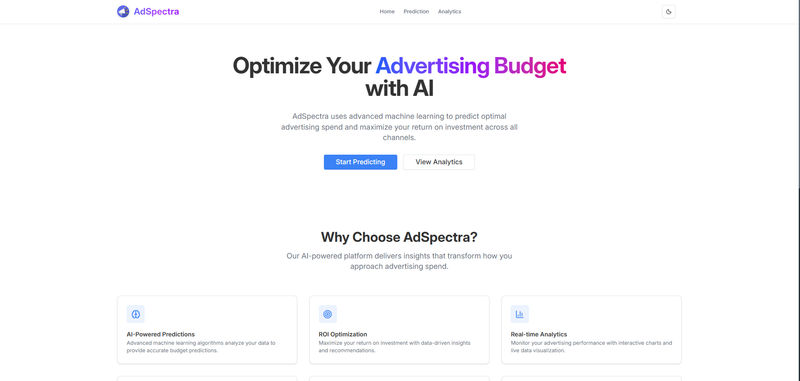
The application is deployed on Vercel, enabling fast global access.
Backend API
The backend acts as the bridge between the frontend and the ML model.
Responsibilities:
- Accept and validate prediction requests
- Preprocess input data
- Run model inference
- Return structured prediction results
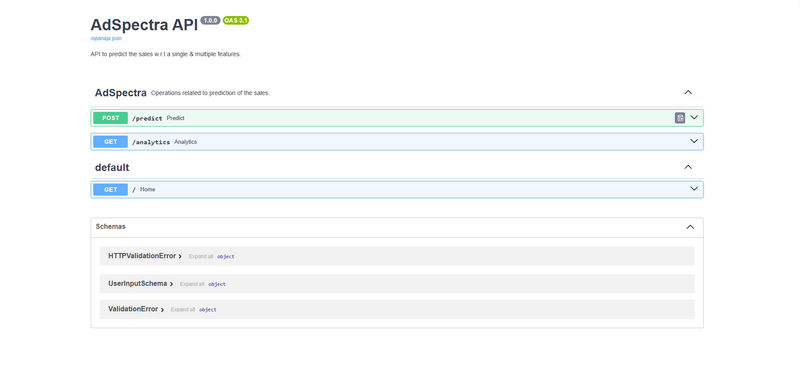
This layer ensures the frontend remains lightweight and focused purely on user experience.
A Faced Issue
During AdSpectra’s development, mismatches between frontend input formats and backend model expectations caused inconsistent predictions. User inputs were captured as strings and varied in structure, while the machine learning model required strictly ordered numerical data. This led to validation errors and unreliable inference in some cases.
The Solution
A strict API contract was implemented:
- Backend validation ensured correct data types and required fields
- Incoming data was standardized before inference
- The model always received inputs in a consistent, predictable format
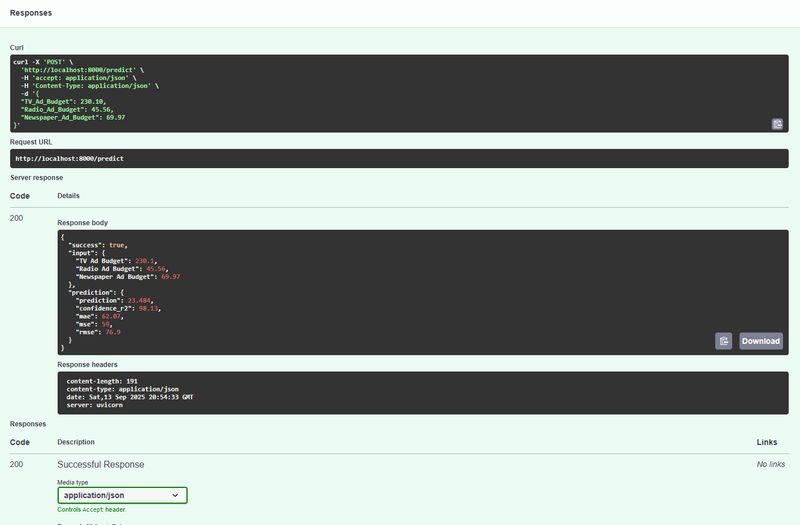
The Outcome
This made predictions stable and accurate, improved system reliability, and simplified frontend–backend integration.
Learnings
- A machine learning model is useless unless it is properly integrated into an application
- Small mismatches in input format can break predictions completely
- Frontend inputs must never be sent directly to a model without validation
- Defining a fixed input structure early makes the system easier to scale and debug
- Debugging full-stack ML apps requires checking data flow end-to-end, not just the model
- Deployment exposes issues that never appear during local testing
Future Improvements
AdSpectra is fully functional with its current API, which handles real-time predictions and serves analytics data reliably. However, several enhancements are planned to make the system more robust and user-friendly:
- User authentication and saved prediction history: Allow users to log in and track past predictions.
- Automated model retraining pipelines: Periodically update the model with new sales data to maintain accuracy.
- Advanced explainability for predictions: Integrate tools to help users understand why the model produces specific results.
- Scalable, serverless inference: Upgrade the backend to handle higher traffic efficiently using serverless or containerized infrastructure.
These improvements will enhance usability, scalability, and the interpretability of predictions, taking AdSpectra from a functional prototype to a fully production-ready application.
🔗 Project Links
- Live Application: https://ad-spectra-livid.vercel.app/
- GitHub Repository: https://github.com/Nil369/AdSpectra
